Fieldwork in the Atacama Desert, Chile

Thursday, 1 October 2020

Paper Summary: Artificial maturation of iron- and sulfur-rich Mars analogues (AKA Is There Life in Dorset?)

Artificial maturation of iron- and sulfur-rich Mars analogues: Implications for the diagenetic stability of biopolymers and their detection with pyrolysis gas chromatography–mass spectrometry (Tan, Royle and Sephton, Astrobiology, 2020) 

AKA Is There Life On Mars In Dorset? 


Gale Crater, Ancient Mars/ St Oswolds Bay, Dorset; the similarities are remarkable.... 

So despite the global pandemic shutting down the lab and having to spend weeks in a Singaporean quarantine centre with coronavirus himself, Jonny has managed to get the lab’s only 2020 paper accepted. It’ll be a few weeks until the final version is online but an open access pre-proofed version of the accepted manuscript can be found here (link). As it’s a quite a long paper and we’re all busy trying to survive the end times, we’ve tried to write a accessible summary here to get the main points across…. 

Around 4-3.5 billion years ago (the Late Noachian to Hesperian periods) the surface of Mars was a much more habitable place than it is today. Increased volcanic activity and a protective active magnetic field maintained Mar's atmosphere. This provided a global warming effect, allowing liquid water to be stable on the martian surface (at least some of the time). Rivers flowed, valleys were formed, and lakes were filled. This is around the same time that life evolved on Earth, and if it also evolved on Mars, or hitched a ride there from Earth via meteorite, it may well have flourished under these conditions. Therefore, our best chance to find evidence of ancient martian life will be in the sediments deposited in this period. 

As well as providing an atmosphere, those volcanoes injected large volumes of sulphur dioxide (SO2) into the atmosphere and made the waters quite acidic. This encouraged the deposition of sedimentary sulphate minerals and iron oxides. On Earth, acidic groundwaters containing dissolved sulphates bubble up in a few places to produce sulphur streams and precipitate sulphate salts, such as jarosite, alongside iron oxides, such as haematite and goethite. These streams provide handy analogues for ancient habitable martian environments, especially as some can be found as nearby as Dorset! 

In a previous paper (link), Jonny already established that organic biosignature molecules (the ‘fingerprints’ of life) are concentrated within the iron-rich phases of the sulphur stream environment and that they may be detected by techniques similar to the capabilities of current and future Mars Rover missions. 

The new work takes this a step further, to see what would be detectable after the nearly 4 billion years that have passed since this most habitable period of Mars. During that time the sediments will have been buried, heated and subsequently uncovered; any sediments that have not been buried on Mars will have had all their interesting organic molecules destroyed by cosmic and solar radiation so there's no point looking in those. We know that the sediments at Gale Crater that Curiosity has been poking at were at one point buried to at least 1.2 km depth. Increased pressure and temperature, when coupled with potentially reactive mineral surfaces, may destroy or at least alter, the evidence of life (organic biosignature molecules) we are searching for. 

Sediment samples were collected from 2 sulphur streams in Dorset, at St. Oswald’s Bay and Stair Hole. These sites are known to be inhabited by weird extremophile microbial life, including acidophilic (acid loving) algae and microbial mats of phototrophic purple sulphur bacteria (they use sunlight to make energy out of sulphur), which thrive in these harsh conditions. 


The sulphur stream, green acidophillic algae and purple sulphur bacteria are easy to spot so should be easy to detect their 'biosignatures'

After being freeze-dried, these samples were artificially matured using hydrous pyrolysis. In this technique millions to billions of years of burial and low temperature heating can be replicated within a few days by using higher temperatures to speed up the reactions (Arrhenius equation). After this any surviving soluble organic matter was extracted with solvents, as in reality this would be lost due to the actions of percolating fluids through the sediment, so we only want to look at the insoluble fraction left behind. To see what effects the sulphates and iron oxides in the sediments had on the detectability of the organic material during the analysis step these were removed using strong acid and alkali washes to dissolve them away for half the samples.


 'Bomblets' and pressure vessel 'bomb' used for hydrous pyrolysis, billions of years of burial in one weekend!

After all this preparation, the samples were analysed by pyrolysis-gas chromatography-mass spectrometry (Py-GC-MS). This technique is similar to the main way that all Mars missions have looked for organic matter in martian sediments/rocks. By heating up the sample organic matter is liberate and volatilised into fragments that can be separated and identified (more details here). This technique, whilst being the simplest way of detecting insoluble macromolecular material (of the type we may expect to be left behind after billions of years of burial) the heating encourages reactions between the organic matter and reactive/oxidising mineral surfaces, which has been a problem in the past (hopefully we’ll have a paper looking at this in more detail out very soon); hence the acid/alkali treatment to remove these phases in this study. 

Unsurprisingly, the sulphur stream samples that had not been artificially matured were found to produce a wide range of organic compounds, consistent from those generated from the pyrolysis of microbial mats from similar environments. The shear amount of organic matter in the sample was able to overcome any issues in detection due to the presence of the sulphates and iron oxides in the samples. However, samples that received the acid/alkali wash still produced a greater abundance and variety of organic molecules than those which did not. Many of the organic compounds detected are diagnostic of biology and have the potential to be used as biosignatures. Some can be related to bacteria, with markers of both anaerobic and aerobic metabolisms present, while others indicate an input of woody higher plant material. 

Pyrolysis-GCMS data showing what organic molecules may be detected from the same sulphur stream sample with different pre-treatment regimes, before and after hydrous pyrolysis and before and after acid treatment 

After artificial maturation/diagenesis, organic matter detectability decreased markedly with increased hydrous pyrolysis temperature as organic matter was degraded. It was not until the sulphates and iron oxides were dissolved away that we could see anything interesting, i.e. nothing diagnostic of life was detected without the acid/alkali treatment! After they were removed it could be observed that many biosignature compounds did, in fact, survive the maturation process, although some were lost or altered.

  
So, why’s this interesting at all? Well it demonstrates that if we only use bog standard thermal decomposition (pyrolysis) techniques to look for organic matter in martian sediments which are rich in sulphates and iron oxides then we’re going to miss out on a lot of stuff, we just won’t see biosignatures that are there! Sulphates and iron oxides are yet another barrier to organic matter detection by thermal extraction strategies and should be avoided where possible. Issues with this may have already happened, the simple organic compounds detected by Curiosity in 2018 (link) look rather similar to what was detected in the un-acid/alkali washed samples and were detected in mudstones with high sulphate and iron oxide contents! If these reactive minerals could have been removed in a pre-treatment step prior to analysis, who knows how much of a greater variety of organic information would have been unlocked, perhaps even the first compelling biosignatures of ancient life on Mars? 
Simple organic compounds already detected on Mars, but what information was lost due to reactive minerals?

Wednesday, 23 September 2020

Sorry Venus, Mars is still where it's at!

 All of the excitement in the astrobiological community of late has been on the detection of phosphine in the clouds of Venus and how this may be a ‘biosignature’ of microbial life in the ‘habitable’ environment of the Venereal (pretty sure that’s the correct term…) clouds. While this detection is pretty damn cool, I do think the detection of a simple molecule that can also be produced from volcanoes and lightning (which we know exist on Venus) or from some other weird high temperature geochemistry (we know sod-all about Venus really) is getting a little over-hyped (in the same vein as Curiosity’s 2018 ‘life’detection).   

Can always rely on the Daily Express...


Now what is worth getting excited about is the Curiosity rover finally carrying out a TMAH experiment this month (after nearly 8 Earth years on the martian surface). For non-organic geochemists; TMAH, or tetramethylammonium hydroxide, is one of the two derivatisation agents carried by SAM (Sample Analysis at Mars, Curiosity’s onboard chemistry laboratory), the other being the even more god-awfully named MTBSTFA or N-methyl-N-(tert-butlydimethylsilyl)trifluoroacetamide.

Thanks to previous experiments by Curiosity, we now know that organic molecules are certainly present on Mars, they may exist as complex macromolecules, and their detectability is affected by the presence of various minerals on the martian surface. The usual technique for detecting organic matter on Mars, thermal decomposition (pyrolysis), is a bit of a blunt instrument, as using heat to release organic molecules from the sediments basically blows them apart (especially in the presence of oxidising salts), destroying structural information and making it difficult to establish their provenance. Because of this, so far, we have only detected simple organic molecules on Mars with much speculation, but little evidence, to their source (reminder – organic molecules, whilst they are the building blocks of life, they can also be produced by many abiotic processes). In contrast, derivatization agents are a really useful tool in detecting and understanding organic molecules as they can liberate organic molecules of interest from macromolecular matter or (potentially reactive) mineral surfaces less destructively and at lower temperatures.

A particularly interesting class of molecules in the search for life on Mars are the fatty acids. Unlike most other (potential) biomolecules fatty acids survive well under harsh environmental conditions over geological timescales (pretty important as Mars’s most habitable conditions were over 3.5 billion years ago) and can contain much information suggestive of their source. Fatty acids, as the name suggests are the main breakdown products of lipids or fats. Abiotic processes (such as hydrothermal processes) primarily produce short fatty acid molecules, whereas life tends to use longer fatty acid chains with even carbon numbers as essential components of cell membranes. The specific lengths and saturation states of these longer fatty acids can also provide clues as to the type of life they came from, bacteria, algae, higher plants all leave behind specific distribution patterns of fatty acid chain lengths. Hopefully I'll be posting a more in-depth discussion of why fatty acids are a good target in the search for martian life shortly as we're trying to get a couple of papers published on the subject...

Oleic acid, an 18 carbon singularly unsaturated fatty acid

However, these potential biosignatures are notoriously tricky to detect as fatty acids (a) are ‘sticky’ and so are hard to get off mineral surfaces in the first place; (b) on heating they break down pretty easily to ‘boring’ alkenes/alkanes which don’t preserve much information about their source; and (c) even if you liberate them from the mineral surface intact they are a polar molecule so the gas chromatograph-mass spectrometer’s (GCMS) detectors only ‘see’ them if present in large quantities (unlikely on Mars).

If a TMAH derivatisation step is applied to the samples before pyrolysis, however, the fatty acids can be liberated from the macromolecules/mineral phases at a lower temperature. Heating in the presence of TMAH hydrolyses organic matter, freeing the fatty acids (and other bound molecules) and also methylates (adds a methyl -CH3) to polar functional groups, including the carboxylic group of the fatty acid molecule. The methylation makes the fatty acid (or other polar molecules) less polar and more volatile, making them more amenable to detection in the GCMS. Here's an open access paper on this technique being used on Mars analog samples if you want (significantly) more detail.

The easier to detect methyl ester of oleic acid

This is exciting as this experiment will be our best chance so far of detecting more complex organic molecules, work out where they are from and ultimately find evidence of life on Mars (maybe). Unfortunately we'll have to wait months to find out the results as the scientists involved will have to carry out all sorts of experiments to validate the rover's findings (especially if they find something that looks particularly interesting).

Further into the future, the ExoMars Rosalind Franklin rover, scheduled for launch in 2022, will have the ability to carry out other derivatisation pyrolysis experiments which work at temperatures down to 250 or 140 depending on the exact technique used. It will also have a laser desorption unit which will liberate organic molecules through millisecond laser pulses, a non-destructive technique. Both of these abilities should preserve more structural information and be less likely to suffer mineral surface effects than any experiments we have been able to do on Mars with Curiosity or any of the previous landed missions. 

Friday, 21 June 2019

The Nemesis Project


I’ve repeatedly heard that every academic, at some stage in their career, has that one project that just won’t behave itself and become a nice little publishable package. Experimental results lead to more questions than answers. Reviewers say the ides are interesting but are unconvinced by the conclusions or have issues in the reliability of the method. You're rejected but encouraged to re-submit. The whole thing drags on for years, quietly ticking away in the background, while research avenues with more promise for short-term gain are chased instead. But the nemesis project never dies, it stays there at the back of your head. Too much time and effort has already been invested, you’re in too deep to give up on it now.

My own mini-version of this has just ended. My nemesis project has just been published in Astrobiology (link, and link to non-paywalled pre-print) 3 years after my supervisor scribbled down a ‘cool idea which won’t take much time to test’ (I may be paraphrasing there, it was a long time ago). This is not my usual post-publication summary of my work, I will hopefully write that soon, instead this is a story of how much behind the scenes failure can have gone into one, small, relatively insignificant, successfully published paper.

The idea for the project came out of the PlanetaryProtection of the Outer Solar System project, which I have written about before (link). In one of the early meetings back in 2016 my supervisor, clearly paying full attention to whatever was being discussed at the time, scribbled a vague experimental idea onto a scrap of paper. This idea was to see if we could use a well-established environmental sampling technique (solid phase micro extraction, SPME) to test spacecraft hardware surfaces for organic contamination.  Now this was interesting as organic contamination is a big issue in planetary protection, we don’t want to send dirty spacecraft with highly sensitive instruments to the (currently) pristine icy moons of the outer solar system. We’d end up only detecting muck from Earth and so either getting all excited over nothing, misinterpreting it for evidence of alien life, or, a real interesting extra-terrestrial signal would be missed, lost in background noise from the contaminants. Current methods employed for detecting contaminants on surfaces tend to be time consuming, complicated and may involve multiple solvents being used in the process – themselves potential contaminants.

The premise was therefore simple: Get some stainless steel to use as a budget stand in for a spacecraft surface, contaminate it, see if SPME (coupled with GC-MS) is sensitive enough to detect contaminants at the levels of cleanliness required for life-detection missions.

The first version of this study just involved leaving some stainless steel L-shaped brackets (bought from a hardware store) out in the lab to collect fallout contamination from the air and also handling them with and without gloves to see if they picked up anything detectable from hand transfer.
To be scientifically valid a study like this must be reproducible, so many repetitions of everything being tested are needed, simple, but monotonous, time consuming work – perfect for an undergraduate summer internship! Georgios, a 2nd year undergraduate and now co-author on the final paper, gave up 6 weeks of his summer in 2017 to do this, creating loads of data for me to work up afterwards. Now initially we thought this first version of the study was pretty good, however the reviewers had other thoughts.

Reject but encourage re-submission.

The issues basically boiled down to our method being a bit woolly and bullsh#t (again, paraphrasing). How could we know what was on the surface to detect and therefore how sensitive the method was if we hadn’t specifically contaminated it ourselves at a known concentration? We’d basically skipped the proof of concept stage and gone straight to real-word testing (well as real as you can get without a real spacecraft)...So yeah, fair enough.

Not having scope to dedicate 6 weeks of lab time to completely redo the experimental side of this study myself, the project had to get shelved until the following summer (2018) when I could get a second student, Yuting, who was keen to get some experience in the mind-numbing, soul destroying boredom of repetitive lab work.

In the meantime, I took the reviewer comments, which despite being rather critical were all very valid and helpful, and developed a whole new method for testing the sensitivity of this technique. This was to be much more scientific, creating a whole range of solutions of astrobiologically-relevant contaminants to contaminate a surface with much better-defined properties (although it was still basically just a steel nut).  

Once again, the student project seemed a success. Yuting produced a shed load of nice replicate data over the summer, which I turned into a completely new manuscript. None of the data set from Georgios’s original experimental run even made it into the new work, and after a few weeks of tidying up and writing we re-submitted.

Again, however, the reviewers didn’t quite agree, while they did think the method was now (mostly) sound, they didn’t agree the results were as promising as we did and wanted more and better data. Almost annoyingly this wasn’t a rejection this time, there was now a time pressure involved with a re-submission deadline. I could have ignored it and waited another year, but there was an end in sight, a way to kill this thing. Jon just needed to work some magic to tweak the mass spec settings to decrease the noise and make the data more convincing. Unfortunately, this meant I now had to repeat all the experimental work with the new settings myself, replicating a whole summer student project in about 3 weeks.

This was not fun, but it worked.

Now at the end of it all, it is clear that without the multiple knock backs and the intermediary time periods to just think about how to improve the methodology, this study would’ve been pretty rubbish. This is definitely a case where the review process has greatly improved an original idea and has shown me that rejections don’t always have to be a bad thing, they can be an opportunity. However, this only took 3 years to take down, I’m not sure how I’d feel if this had grown into some 5 or 10 year, or even career-spanning, monster.

Maybe that’ll be the next quick project…

Wednesday, 8 May 2019

Washing samples to detect 'Martian' organic matter


The beginning of this year seemed to be a good time for our group getting papers accepted and the third of those that snuck in is now online in Astrobiology:


Once again, we’ve been looking at the troublesome effects of perchlorates on the detection of organic molecules, only this time we’ve used the Atacama Desert as a stand-in for Mars.

I’ve discussed the ‘perchlorate problem’ on Mars numerous times on this blog as it’s what I’ve been working on for the last couple of years (although not any more, watch this space). In short, oxygen-rich salts (of which perchlorate is probably the most problematic) are present in the Martian soil, we also expect there to be organic matter present (note, organic does not necessarily mean biological, see previous rant). With Mars lander missions, such as Curiosity, we attempt to detect the organic matter in the soil by heating the samples up in an oven to break down large molecules into smaller (more volatile) fragments that we can detect. However, those salts also break down when heated, releasing oxygen. This oxygen causes the organic matter to combust and any interesting organic molecules ‘burn up’ and are lost as carbon dioxide and carbon monoxide gases. This explains the difficulty that Mars missions have had in detecting organic matter on the surface, there has only been a single successful detection, which I’ll come back to later.

Mars today is a hyper-arid environment. While there may have been flowing rivers, lakes and even seas on the surface in the past, nowadays any liquid water anywhere near the surface is very rare. This allows the build-up of perchlorates and other salts which are highly soluble and would otherwise be washed away, which is why they are rare on Earth. This is where the Atacama Desert comes in as, recent floods notwithstanding, this is one of the driest places on Earth and so is one of the few places where perchlorates are present in the soil in significant amounts. This, combined with the low abundance of organic matter in the desert soil, due to its inhospitability to most life, makes the Atacama a (relatively) easy option for testing out ideas about Mars.

A rather Martian looking dawn in the Atacama Desert


The whole premise of this study can essentially be boiled down to: if these perchlorates are so soluble, can we just wash them out of our samples to allow us to detect the trace amounts of organic matter that we previously could not detect?

The answer, it turns out, is yes.

When the desert soil samples were initially analysed, by heating them in a similar fashion to what is carried out on Mars, showed little or no evidence of any organic matter being present.

Sub-samples of those soils were then well washed in very pure water, filtered and then dried. Unsurprisingly, analysis of the water showed that it had dissolved most of the soluble salts from the soils and it did not appear to have washed away any organic matter (which is mostly insoluble in water).

Once dried, analyse of these leached (washed) soil samples now allowed the detection of a variety of organic molecules. The molecules detected were indicative of the presence of cynobacteria (algae) that are known to be able to grow even in the dry desert.

This was, all-round, a pretty good result!

This potential for the problematic salts to be washed away has some pretty exciting implications for our search for organic matter on Mars. If we want to get around this ‘perchlorate problem’ we can either:

1. Wash our Martian samples with water. This, however, introduces a whole host of issues. Do we take water to Mars, it’s pretty heavy and we risk creating a nice, wet habitable environment for any Earth microbes that have hitched a ride, a major issue for planetary protection. Do we produce water on Mars by melting water-ice or extracting it from hydrated minerals, again, this would probably upset the mission’s Planetary Protection Officer (yes, this is a real job).


Buried ice exposed on steep slopes could be a useful water source

2. Go look for areas with evidence of ‘recent’ water activity on Mars were the salts will already have been leached away for us. This is the ‘easy’ option and what may have already happened accidentally. A rock unit called the lower Murray mudstone is the one place on Mars where evidence of complex organic matter has been found so far, co-incidentally this unit also has one of the lowest concentrations of perchlorate yet measured on Mars. There is evidence that, after the mudstones were deposited and buried, fluids flowed through the rock. These fluids could have leached away any soluble salts originally present, leaving being the insoluble organic matter, making it easier to detect. Areas with evidence of current or more recent water activity, such as above near-surface aquifers and near exposed and melting water-ice could also be promising areas to check out, however, these will also present planetary protection issues if there is liquid water available to support life.


Mineral veins show evidence of fluid flow, these fluids may have 'washed away' the soluble salts


This was actually a project that Wren had been trying to get published for a while now and the whole organic matter: perchlorate ratio paper we published last year actually originated as a response to reviewer’s comment to one of the early drafts of this current work. Happily, the two studies agree with each other, and NASA’S detection of organic matter which was announced while we were working on the re-write, pretty nicely (which is always good).


Tuesday, 12 March 2019

Scientists blew up a piece of Mars, you’ll be amazed what they found out!


Or: Indigenous Organic-Oxidized Fluid Interactions in the Tissint Mars Meteorite, Jaramillo EA, Royle, SH, Claire MW, Kounaves SP and Sephton MA. (2019). GRL

Apologies for the clickbait title, it seems as though this is now compulsory with all space-related scientific writing. I did blow up a piece of Mars though and I did find stuff out, you can read all about it in a paper I co-authored which is now published in GRL. Alternatively, here is a summary, it is massively biased towards the organic geochemistry side of things as that is the bit I did (and the only bit I really understand).

On the 18th July 2011 a meteorite was observed exploding over the desert in Morocco. Over the following few months fragments were collected near the village of Tissint, which the meteorite has been named after. Very few meteorites have actually been found so soon after impact, usually they have sat around on Earth for many years. In this time they become contaminated, they sit in dirt, water flows through them and (Earth) microbes make them their home. Previous studies have shown that the Tissint meteorite is actually a piece of Mars; Martian igneous rocks that were formed around 600 million years ago were blasted off into space by a large meteorite impact on the surface of that planet around 1 million years ago. This means that the Tissint meteorite gives us a unique opportunity to explore the geochemical processes happening in the Martian crust, with the freshest samples we’re going to get until (if) Mars Sample Return happens.

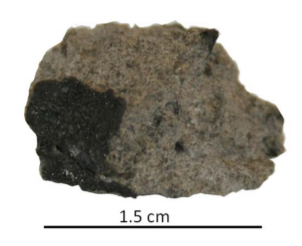
the fragment of Tissint used in the study

Elizabeth, the lead author, had collected samples from the fall site and analysed them, along with fragments of the meteorite to compare their salt contents as part of her PhD. This had raised a few questions that needed answering, so I was drafted in to pyrolyze (i.e. flash heat/blow up) the same samples to see what organic molecules were present and what they could add to the story.

Tiny bits of Mars ready for me to grind up and pyrolyze

As I have mentioned before in my posts, organic does not equal biological. We were not looking for aliens here, organic molecules are just those molecules that contain carbon and hydrogen. While they are the ‘building blocks’ of life, they also form from non-biological process, including in space and in hot fluid (hydrothermal) systems deep underground. As such they are common in meteorites and comets and we expect to find them on Mars.
Looking at the organic content had 2 purposes: 

1. We wanted to know if the meteorite showed signs of becoming contaminated in the short period of time before it was found (biologically sourced contaminants from Earth-bugs finding their way into the samples would be pretty easy to spot);

2. If no signs of contamination then we hoped to identify actual Martian organic molecules and see what they could tell us about ancient Mars.

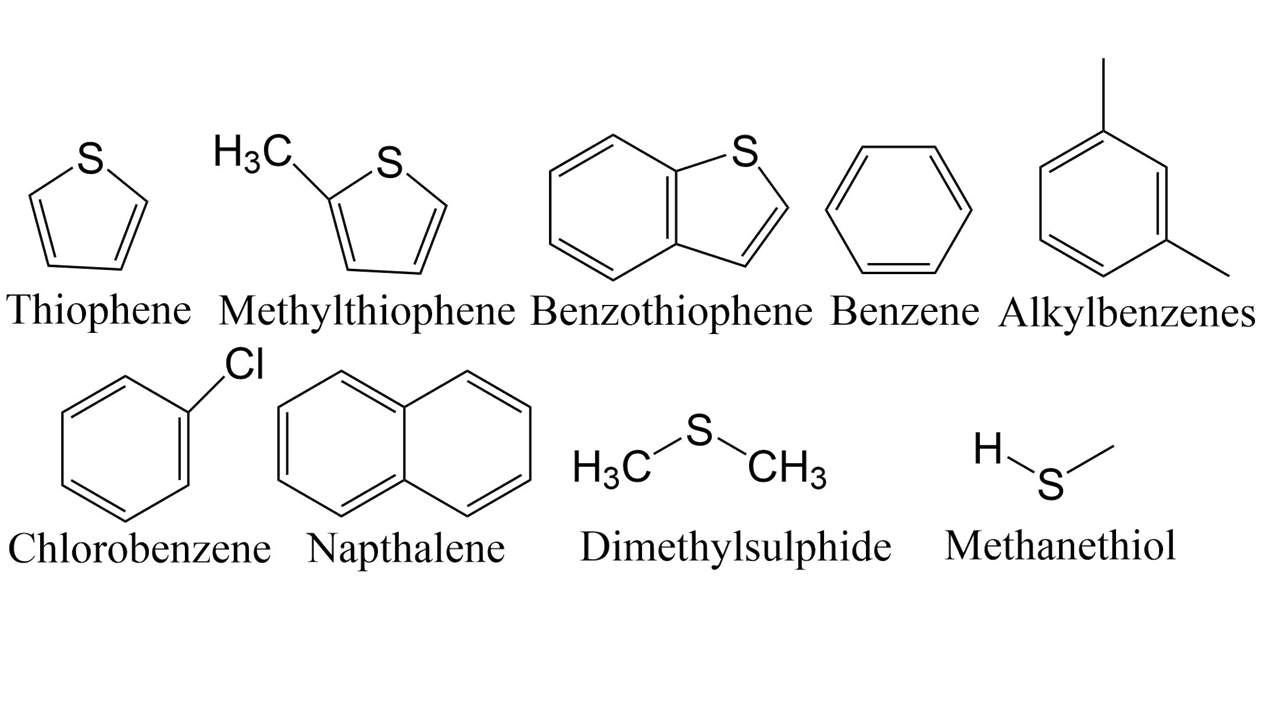
Neither the inorganic salt content nor the organic molecular compositions of Tissint suggested that the meteorite was contaminated (Yay!). While I detected evidence of microbial life in the soil samples, these hadn’t got into the meteorite. What I did detect in the meteorite were simple aromatic (ring-shaped) organic molecules, some of which contained sulphur. This was quite exciting as these were the same kinds of compounds that have been found in other Martian meteorites AND on the surface of Mars by the Curiosity Rover. Suggesting that we had detected actual Marian organic matter!
Organic molecules found on Mars (by Eigenbrode et al. (2018)), we also found various thiophenes, alkylbenzene, chlorobenzene and napthalene in Tissint, along with other sulphur-bearing compounds 
The mixture of salts and organic molecules within Tissint suggest that less than 600 million years ago, recent in Mars-terms, an oxygen-rich, salty water-brine flowed through the near-surface crustal rocks of Mars. Electrochemical reactions likely formed both the organic molecules and the salts in this fluid as reactions occurred on the surfaces of variously charged minerals.

As the composition of this fluid was similar to seawater and, there was a readily available source of organic carbon as a food source, this could have produced a temporarily habitable environment near the surface of Mars during the late Amazonian period. This is much later than the surface of Mars was potentially habitable and although we don't go as far as saying anything actually lived in it, it could have done....

Friday, 12 October 2018

Summary: 'Survivability of 1-chloronapthalene during simulated early diagenesis...' (more exciting than the title suggests, honest!)


The shiny full open access version of our latest paper about organic molecules on Mars is now published online at JGR Planets. While we'd like you to read the whole thing to justify the ridiculous cost of publishing open access, if you can't be bothered then here's a summary, which should be relatively understandable.

When missions to Mars are looking for past or even present life, the evidence they are searching for is in the form of organic molecules. While not all organic molecules are formed by biological activity, some compounds, like certain fatty acids, are what we term ‘biomarkers’ and the detection of those would be very exciting as they would be a strong indication of Martian life.

Even detecting non-life-related (abiological) organic molecules on Mars would be exciting, we are sure that they should be present on Mars as the universe is full of them. Meteorites and comets are rich in organic matter, sourced from the primordial material of the early universe, and Mars must have been ‘seeded’ with these ingredients for life in much the same way as Earth.

Most attempts (bar one) to detect organic molecules on Mars, however, have only found simple chlorinated organic compounds – those with one or more chlorine molecules attached. These are not what we would expect from any of the proposed sources of organic matter on the Martian surface, they are too small and simplistic, and the chlorination is a bit weird,  and so something must have altered Martian organic matter to create them.

But when? and how? This is what we have tried to figure out....
Simple chlorinated molecules found on Mars

2 competing hypothesise for the source of these chlorinated molecules have been put forward by previous work:

1) It has been suggested that they may have formed on the Martian surface via reactions between chlorine-bearing salts (especially the perchlorates that I work with) and those organic compounds delivered by meteorites. In this case, the chlorinated organics discovered by the Curiosity Rover would be as 4.5 billion years old, the same age as the rocks they were extracted from. They would have had to survive the increased heat and pressure of being buried to about 3 km depth on a warmer ancient Mars.
The Sheepbed Mudstone, Gale Crater, Mars, where Curiosity has found most of the chlorinated compounds (from Sutter et al., 2017)

2) It has also been suggested that they are formed inside the analysis instrument of the Rover when organic carbon (either from the analysed Martian rocks or just contamination from Earth) is heated along with chlorine-bearing salts that are also known to be in the samples. The salts break down when heated to produce both oxygen and hydrochloric acid which reacts with any organic matter present. In this scenario, anything interesting is mostly burned away to carbon dioxide and carbon monoxide and lost to detection with the few surviving fragments of organic molecules becoming chlorinated. In this case the detected molecules would be formed just before detection and so survivability is not an issue.

To test if the first hypothesis was even possible we examined the ability of simple chlorinated organic molecules to survive the high pressures and temperatures associated with burial over geological timescales. We did this by subjecting these molecules to geologically-relevant pressures in a small reaction vessel, known as a bomblet, which is basically a glorified pressure cooker. Obviously we didn’t have a few billion years to wait around so we had to speed up the process. By increasing the temperature to speed up the reaction rate (remember high school chemistry?) we squeezed most of the history of Mars into a weekend.

How to squeeze 4.5 billion years on Martian geological history into a weekend. Clockwise from top left: Freshly made bomblets ready to be filled with the test chlorinated compounds. Sat inside the larger bomb - the whole thing can be filled with larger volume of sample if necessary. Making sure everything is tight so it doesn't explode when pressurised. Heating up in the reaction vessel to cook for the weekend.

By repeating this experiment at various temperatures and pressures, it was possible for Jonny Tan, one of the PhD students in the research group, to do some fancy maths and computer simulations stability of the molecule under conditions it would be subjected to on Mars. This bit was all over my head, but if you want to play around with his model, its all open source and available on github.

It was found that the bond between the chlorine atom and the rest of the hydrocarbon molecule is quite weak and breaks easily. This means that, on a warmer ancient Mars, when the sediments the chlorinated molecules were detected in were deposited, the increased surface temperatures would have promoted the loss of chlorine relatively rapidly. Intact chlorinated organic molecules would have been unlikely to even survive the first 1 billion years, never mind the 4 billion needed to get to the present day in detectable concentrations. This makes the first hypothesis (that these molecules formed on the Martian surface and are ancient) rather unlikely.

The chlorinated organics detected on Mars in ancient sediments are therefore likely to have been formed very recently, most probably when heating in the Rover's analysis oven promoted reactions between Martian organic matter and chlorine-bearing salts.


Whilst this conclusion isn't going to blow anyone's mind, as most studies had assumed this anyway, it's good to have some actual experimental evidence to back these things up.

Friday, 27 July 2018

Latest (catchy titled) paper summary: Perchlorate‐Driven Combustion of Organic Matter During Pyrolysis‐Gas Chromatography‐Mass Spectrometry: Implications for Organic Matter Detection on Earth and Mars

Credit: JGR: Planets

Our latest paper is now out and openly accessible to read here. I’d rather like you to read the full version so we can justify the £2500 it cost to remove the subscriber-only paywall and make it open access. However if you CBA to plough through all the technical jargon (there’s not too much I hope) here’s a little (hopefully) more accessible (and shorter) summary of what we found out.

As you probably know if you’ve read any of my other posts, my research is mostly on the interactions between organic matter and minerals on Mars, with the overall aim of trying to figure out why we’re having such a hard time detecting organic matter on the Martian surface. If you’re new here then what you need to know first is that organic matter, in this sense, does not necessarily have anything to do with life (whatever recent headlines have said). Organic molecules are just molecules that contain carbon, they are the building blocks of life BUT can also be produced from non-biological processes – even in deep space.
We know that organic matter should be widespread on the Martian surface as it will be delivered there by meteorites, comets and interplanetary dust particles. There may also have occurred processes in Martian history that created organic molecules on Mars itself (although this is less certain), and if there is, or has, ever been life on Mars then that would also leave behind molecular traces of itself. Even if the only source of organic matter to the Martian surface is from outer space, and the high radiation environment of the Martian surface (there’s very little atmosphere for protection) breaks that down somewhat, the constant delivery of organic matter over billions of years should have left something behind we can detect.

Oddly, though, despite trying since the Viking life detection mission back in the mid ‘70s, we have failed to detect any evidence of complex organic matter until very recently (more on that later). All attempts to look for organic matter in the Martian rocks and soil have used thermal decomposition – heating up the sample in an oven so that anything in there breaks down into small enough molecules to be identified by the on-board instruments. However, mostly, they only detected (at best) very simple, small, chlorinated organic molecules along with carbon dioxide and carbon monoxide gases. Not as interesting as we’d hoped.


Simple, chlorinated organic molecules found on Mars previously

The discovery of perchlorate in the Martian soil by the Phoenix lander in 2008 gave an answer to this puzzle of the missing organic matter. Perchlorate is an ion made up of 1 chlorine and 4 oxygen atoms, when you heat this up it breaks down to produce lots of oxygen – it basically explodes! This makes it useful for rocket fuel (ammonium perchlorate was used as the propellant for the space shuttle rocket boosters) but not so useful when you’re looking for tiny amounts of organic matter which are in the same soil/rock sample. When you heat up a sample that contains both perchlorate and organic matter the oxygen release causes the organic matter to combust (burn away) and be lost as carbon dioxide and carbon monoxide – not helpful for analysis.

We therefore wanted to find out the true potential of this reaction for destroying evidence of organic matter to answer the question: How much organic matter, relative to perchlorate, do we need in a sample to be able to detect it? If we could answer this, maybe we could figure out where, if anywhere, on Mars could have a ratio more favourable for detection.

To do this I made up lots of different mixtures of magnesium perchlorate and charcoal, (charcoal is superficially similar to the organic matter in meteorites, but much more accessible) and flash heated these samples to see what gases they gave off. By analysing the relative proportions of carbon dioxide and carbon monoxide given off it was possible to rapidly see the extent of combustion. If there was too much perchlorate/too little organic matter in a sample then all of the organic matter’s carbon would be saturated by oxygen - complete combustion - and only carbon dioxide would be given off. If there was too little perchlorate/too much organic matter for this to occur then it would be the oxygen that would saturate and not all of the carbon would be combusted, this incomplete combustion would produce carbon monoxide as well as carbon dioxide and there would, in theory, also be surviving organic molecules that were not burned away. The point at which we started producing carbon dioxide was termed the critical ratio.

If we have too much perchlorate and not enough organic matter (subcritical ratio) then there is enough oxygen produced to saturate all the carbon so the organic matter is fully combusted to carbon dioxide. If we have enough organic matter and less perchlorate (supercritical ratio) then we run out of oxygen, not all of the carbon can be saturated so we have partial combustion, producing carbon monoxide as well and organic molecules can survive to be detected. 

It turned out that this critical ratio was about 11 times as much charcoal as magnesium perchlorate. And by doing some maths we figured out that this meant (as the charcoal is a little over 50 % carbon) that on Mars you’d need about 6 times as much organic carbon than magnesium perchlorate in a sample to be able to detect it.

While this paper was out in review, there was a big NASA announcement (link to paper and summary). They’d finally found evidence of complex organic matter on Mars, but only in two samples. This suggested to us that for some reason these ‘new’ (they were analysed in 2015, it just took a long time to get the work published) samples must have an organic carbon/perchlorate mixture above our critical ratio and all the other samples previously analysed must have one below the critical ratio. Thankfully for us, someone had made and published those measurements of perchlorate levels in all of the analysed samples. It turned out that, yes, the samples that showed evidence of complex organic matter had about a tenth of the perchlorate content as the samples that only simple chlorinated molecules were detected in – kind of nicely proving our point for us, thanks NASA!


More complicated organic molecules that have recently been detected on Mars

This demonstrated that the perchlorate levels on Mars are variable and that this is important. If we want to find any more organic matter to increase our knowledge of extra-terrestrial organic chemistry, or even for life detection, we must look where the perchlorate levels are reduced. Perchlorates are highly soluble, this is why they are rare on Earth except in hyper-arid regions such as the Atacama Desert, so we should be looking for areas of recent water activity where they may have been washed away.

Where should Curiosity look next? (Credit: NASA)