Fieldwork in the Atacama Desert, Chile

Wednesday, 27 April 2016

Interviewing a Very Confused Geologist

Monday saw my first post-doc interview, for a job at Imperial trying to figure out how to analyse samples to find evidence for organic molecules on Mars. I’ve had a fair few interviews over the last year but they’ve all otherwise been for part-time, outdoor-industry-related sales and service jobs in Norwich where my expert levels of kit fetishism and experience of actually having seen mountains have been enough to see me through. This, on the other hand, was intense.

In the week running up to the interview I’d not had a single day off to prepare. With perfect timing I’d just started back in the Stable Isotope Lab on a short-term pilot study (more on this in a later post). Preparing samples three days a week, the other four spent working my day job as a children’s entertainer and belay-monkey at the climbing wall. Preparation for the interview, writing a 15 minute presentation on my easiest- to-explain-but-not-necessarily-my-best paper and reading the research group’s latest papers on over my head level chemistry IN SPACE, had to be crammed into a continuous work – prep – train – sleep cycle.

One of the day jobs - snail crushing!

After a particularly intense Sunday-Funday of stopping small children killing themselves, I had to get the late-night train down from Norwich and spend a night on a mate’s sofa (thanks Jimmy). As anyone who has ever tried to escape the transport-link black hole that is East Anglia will know, this is preferable to trying to get out whilst in a hurry, as there'll probably be a tractor on the line or something. Having spent the past 5 years living at the rather sedate pace of Norfolk, navigating the Underground while fighting the London rush hour was a rather unpleasant wake up call to what city-life could be like if I do manage to get a ‘real’ job, although thankfully all the lines were running for once.

Arriving at the Royal School of Mines, with suit intact and plenty of time, I almost walked straight past the building. Its Classical style with pillars and huge, imposing sculptures of benefactors to the school defended by giant half-naked warriors carved out of Portland stone is such a far cry from the bleak 60’s concrete monstrosity of the UEA Teaching Wall that I have become accustomed to university buildings looking like.

The Imposing architecture of the Royal School of Mines - Image from Imperial.ac.uk

The interview started quite well (I think), my presentation on my paper from last year on the stable isotopic records of Cladocora caespitosa (can be read here if you’re interested) being met with nodding heads, smiles and no devastating questions from the three interviewers. I answered all the standard ‘How to you think your skills will translate to this project?’ and ‘Why do you want to do this’ questions without too much waffling and hopefully the right amount of science, the question checking I’d actually bothered to read their papers wasn’t too bad, and it even turned out one of the panel, the main PI, was a climber.

Then it all came crashing down, they fired a ‘basic’ chemistry question at me, ‘We have found [complicated mineral name I’ve never heard of] and [even more complicated mineral name I’ve never heard of] on Mars, what does this tell you about the chemistry of the water?’ I froze; mind blank, where did THIS come from? It was all going so well. I haven’t done real chemistry since my GCSE’s; I’m just a geologist that likes to play in the lab with the shiny machines (hence the Blog's title). This wasn’t the kind of thing I could even try and wing, I was fully out of my depth here, ‘I’m sorry, I don’t know’ was all I could say. This was it, game over…maybe, we’ll see...


So now that’s it, wait and see if all that I could do was enough. Not holding my breath for this one, it’d be a great project to be on, but I expect the competition to be pretty stiff and probably know their chemistry a bit better. If nothing else it was good interview practice, any others will hopefully have a less stressful run up to them. And I did get a chance for a good catchup with an old university mate and a quality bouldering session at the Climbing Hanger while I was down there, so it wasn’t all bad. Now back to the process of finding more job adverts I can tenuously apply my skillset to and firing off applications.

Thursday, 21 January 2016

On the (job) hunt/ Scraping the academic barrel

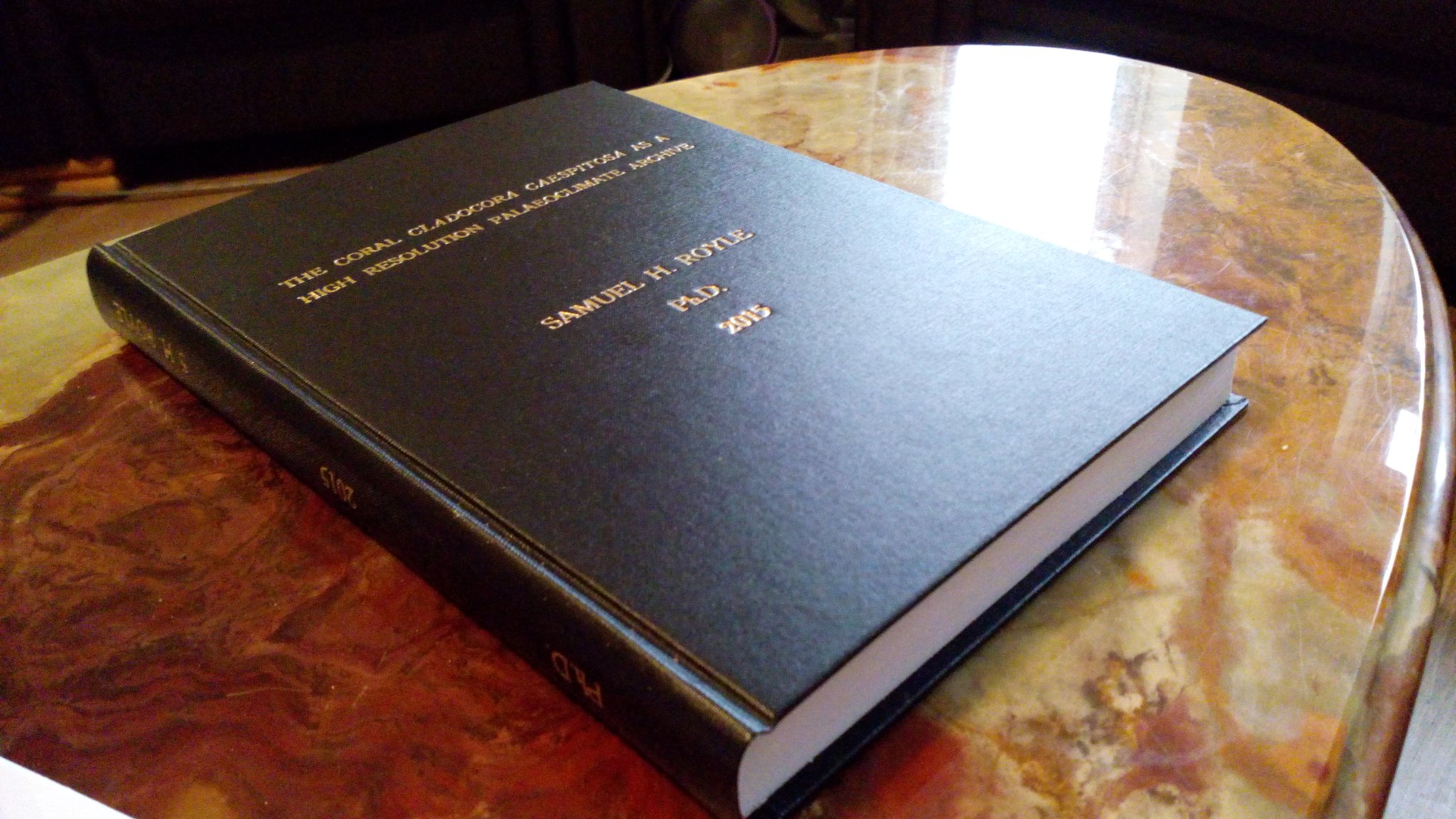
So it’s now been two months since the thesis was finally handed in in all its finished hardbound glory. After the relief of December’s graduation and a chilled Christmas and New Year, the cold harsh reality of having to sort out my future has finally hit.

The last few months were spent doing nothing more taxing than coaxing children up climbing walls and beard cultivation. Therefore, having to sit down at my desk (read: lying in bed) putting the hours in searching for and applying for real jobs has been a serious shock to the system. Almost all of my spare time – that is time not spent at my ‘real’ job as a climbing instructor/coach – is currently spent trawling the websites of various universities with Earth/Environmental Sciences departments, multiple job sites and plugging my details into application forms. It turns out that job hunting is actually like a part-time job in its own right: time consuming, dull and (so far) unrewarding.
The current day job, that's me in the bright orange

Now this isn’t to say that that I’ve not found anything worth applying for, I have applied, and am in the process of writing applications for, really interesting sounding projects. However, every one of my applications has gone along the lines of:

‘Hey, I’m Dr Sam, I really like doing geochemistry of carbonates and stuff and I know things about geology. HOWEVER I don’t really know a huge amount about the specialised stuff you’re doing but it sounds cool and I’d like to give it a bash if you’ll let me’

as nothing so far has completely coincided with my field of expertise. Basically applying for an advertised post-doctoral position seems like trying to extrapolate your very specialist knowledge, really scraping the barrel, to create tenuous links with the very specialist knowledge needed for the project. I kind of feel like anyone reading my applications would think I'd be like this…


So if anyone reading this does know anyone who is looking for a carbonate geochemist with a real interest in using multi-proxy techniques for palaeoenvironmental reconstruction or changing geochemical conditions during formation/diagenesis, please send them my way.

I need a job, like really need one…serious

Friday, 20 November 2015

Trace element paper finally published!


My paper based on the third chapter of my thesis is finally published: 'Environmental and diagenetic records from trace elements in the Mediterranean coral Cladocora caespitosa'. This one looks at the analysis of coral skeleton trace element content to attempt to extract palaeoclimate information.

This was the part of the thesis which caused the most problems: the most time spent in method development, the most time swearing at broken machinery and the most time confused and frustrated by meaningless data – over a year of the PhD all in all.

Turning the chapter into a paper proved just as difficult, we originally submitted the paper in February and I got back to thinking about isotopes (and working at Go Outdoors) for a few months. It took until July for the reviewers to get back to us…they’d been busy, very busy ripping apart the paper – major revisions needed. I received the list of required revisions while on holiday, read it, swore and wrote off the paper as impossible to fix, ignoring it for the next month. Luckily (?) my supervisor was less pessimistic and reckoned it was doable – even if neither of us knew what half the corrections meant. So we begged an extension and got to it. The reviewers’ main issue was the total lack of the statistical analysis (I’m not a stats person at all). The addition of regression analysis, correlation coefficients and frequency analysis turned the study from a thrown together piece of work into something resembling a legitimate scientific study, which was accepted at the start of October. Taking almost 9 months from the initial submission to the final version being available online.

The full paper can be read here (without a subscription until the 8th of January thanks to Elsevier’s sharing policy), but here’s a summary of the main points:

I fired lasers at coral (Cladocora caespitosa) skeletons: modern ones from Croatia and fossil ones from Greece. The fossil ones date from the last two interglacials: MIS 5e (108-133 thousand years ago) and MIS 7a or 7c (186-195 thousand years ago). This allowed us to measure the trace element content of the coral’s skeleton at a very high resolution (every 200 μm – about a fortnight’s growth) to look at how it changed throughout the year. This is important as trace element uptake by corals is linked to water temperature and therefore could be a good palaeoclimate indicator.

We found that individual modern corals do indeed record seasonal variation of sea surface temperature in both their strontium and magnesium contents. However, every coral analysed demonstrated a different relationship between temperature and trace element content. This is because each growing coral is putting an individual, strong and unpredictable biological control (a vital effect) on the elemental uptake. This means that a universal calibration equation to link trace element content in this species of coral to temperature is impossible to produce. This means that we were unable to calculate growth temperatures for the fossil corals – which is what we were really trying to do.

What we did find which was interesting was that one of the modern corals contained a massive spike in trace element contents which coincided with the 2007 wildfires which engulfed a large area of Croatia. This showed that these corals can be used to inform on any events that cause increased sediment discharge into the coastal zone – such as fires and floods – which could allow fossil samples of these corals to be used to discover whether these events happened more or less frequently during the past interglacials and thereby giving some indication into the past climate.


In other good news this week the final hardbound copy of my thesis is now handed in and I’m due to graduate next month – so I finally get to change everything to say Dr on it.


Friday, 29 May 2015

'It's Dr Royle to you'

I had my viva last week; the culmination of nearly 4 years’ worth of experiments and writing to finally gain my PhD. The thought of being grilled, and potentially torn apart, by two experts in my field (of palaeoclimate and carbonate geochemistry) should have been a terrifying prospect; however I felt strangely unconcerned in the run up.

Procrastination in the week before the viva involved mushroom picking, a three day trad climbing and camping trip to the Peak District and a full day at a climbing wall down in Suffolk – leaving just enough time to read through the thesis twice and stick post-it notes on the important pages!

Taking viva prep. seriously

This probably wasn't the best way to prepare but it did mean I hadn’t been stressing about what was going to happen all week and so was calm come the morning of the viva. Turning up to the department wearing a suit and tie (rather than my usual shorts) felt a bit weird and resulted  in a fair bit of abuse being shouted down corridors – apparently I look like a ‘gorilla in a suit’.

Sitting down in the viva room was when The Fear finally hit, seeing the examiners with their copies of my thesis covered in notes, questions and corrections – the shear number of red ‘major edit’ post-it notes on the external’s copy filled me with dread, ‘Shit, it’s major corrections, I'm going to end up like Andy and never graduate’.

So much red

However, I needn't have worried, as many had already told me (although I hadn't believed) the viva was actually quite an enjoyable experience. Having the opportunity to discuss my work and ideas with two people who (at least seemed) actually interested in what I had been doing and what I had to say about my science was quite novel. Most of the corrections were oversights on my part with how I'd presented the data and the thesis should be a lot better for them once completed, with (thankfully) no real issues with the science itself – so no more time in the lab (for the PhD anyway)!

Three and a half hours later and it was all over, PhD passed with minor corrections, champagne in the coffee room and an evening celebrating properly in The Fat Cat.

Prepared for any outcome


The viva ‘experience’ was everything that handing in (see The Great Anti-climax) wasn't, bringing closure to the PhD in a proper, final way. It seemed to both validate and celebrate all the hard work that went into the last few years, so that the final version of the thesis should be a document I can really be proud of.

If I could offer any useful advice to anyone faced with their viva it would just be to not worry too much, if you've got to this stage, as long as you know what you've written (or what you meant to write) it'll probably be fine - or they've already failed you whatever you say in there - so just enjoy it!


Sunday, 19 April 2015

The Great Anti-Climax

I've been meaning to write this post for a while now.

It’s now been about 6 weeks since I handed my thesis (The coral Cladocora caespitosa as a high resolution palaeoclimate archive) in after three and a half years working solidly on it at UEA. All the work, years of my life, stress and swearing that went into it all fit into about 45,000 words – which doesn't seem like a lot when you realise it’s only 35 words per day of the PhD.


There was no grand finale, no fireworks, no celebrations, the copies of the thesis were printed off, bound and handed in with no more than a ‘Well done, that must be a relief.’ from the office staff. After so long working on it actually finishing and handing in was a great anti-climax, and I actually felt a little bit sad that it was over rather than any kind of relief. It was almost some sort of Stockholm syndrome, I’d developed some sort of dependence on working on the thesis at the same time as hating the damn thing.

Now the thesis is done and the funding is all gone I'm now back in a part time, minimum wage job (retail assistant at Go Outdoors, Norwich) like the last three and a half years never happened. It is nice to have a break from science but I do feel that if I stay there too long my brain is going to shrivel up and die from complete lack of use, it seems as though I've already gotten stupider in the last 6 weeks (having managed to miss a few shifts, lose things and, most of all, write a car off).

It’s now a case of waiting for my viva (thesis defence) in a month’s time, hoping that they don't completely rip the thesis apart and I only get minor corrections to do so I can start looking for a ‘real’ job. I still have lab work to do for a clumped isotope paper that needs finishing off but I can’t get on the mass spec. for a couple of months yet as there’s a queue of people desperately trying to finish off their own PhD’s. And I’m still waiting on the proofs for my stable isotope paper and the reviewer comments on my trace element paper (both on the coral Cladocora caespitosa). So all in all it’s just been a period of quiet waiting; not really the great celebration I always thought would be waiting at the end of the thesis, but maybe it’ll get better after the viva. Maybe…


This post might sound pretty negative but I don’t regret coming to Norwich and doing a PhD at all. It’s been a great (although frustrating at times) experience, these have probably been the happiest few years of my life so far. I've met many great people (including the amazing Charlotte who got me through a lot of the shittier bits of the write up), had some great experiences – mostly with the UEA Fell and Mountaineering Club, and discovered (hopefully lifelong) passions for running and climbing, while doing all of the science.

It's not been all bad

Monday, 2 February 2015

My First Lecture

So the other day I gave my first undergraduate lecture, An Introduction to Fossils, as part of the second year Skills for Earth Scientist’s module. I was asked to do it over Christmas as the Professor in charge of the module is a full-on physical sedimentologist, with a total disdain for anything living that might wiggle around and mess up her nice strata with its bioturbation and burrowing.

My first thoughts were that of horror and panic as I imagined a classroom full of half awake, hungover, dead-eyed students staring at me blankly while I struggled to remember the difference between the different forms of rhabdosome in graptolites. Luckily, however, it was explained that this was a true introduction and most of these students had absolutely no prior knowledge on the subject so I was to keep it basic – Panic over, I'm good at basic.

A couple of mornings and my trusty undergraduate textbook of Rhona M. Black, The Elements of Palaeontology (1970) was all it took to throw together half an hour covering such basics as:

       What is a fossil? And the differences between body and trace fossils
       Why are we interested in them? What are uses? (biostratigraphy, palaeoenvironmental reconstruction, oil exploration, etc.)
       How do fossils form? (Moulds, casts, etc.)
       What conditions aid fossilisation? - Preservation potential, lagerstätten, bias in the fossil record

And of course plenty of pretty pictures of the various types of common invertebrate fossils to (hopefully) keep everyone interested.

When the morning of the lecture came, I was surprisingly chilled out about it and – aside from blank faces and awkward silences whenever I asked the room a question – all went quite well. Nobody threw anything, fell asleep, or walked out early – they all even stayed long enough to practice drawing and labelling an ammonite (even if a few did just draw random spirals instead of actually looking at their specimen properly). The follow up practical was pretty good too, an hour of drawing various common fossil specimens in the lab resulted in some nice sketches of trilobites, crinoids and echinoderms – here’s my example sketch of a Micraster I did to show what was expected:

My sketch of a Micraster cast
So, all in all, it was an unexpectedly enjoyable experience – now I just need to (finally) finish my thesis and find a university that’ll pay me to do more of it…

Friday, 18 July 2014

The Geology of the Peak Grit

With the majority of my time working on the PhD at the moment spent just reading papers while sitting around waiting for a final massive data set to work on and the mass spectrometer to be fixed so I can finally finish my data collection, I'm at a bit of a loss as to what to do with myself. This gives me a perfect excuse to put together this blog post I've been meaning to write for a while now, bringing together two of my favourite things: geology and climbing.

Now obviously rock climbing couldn't exist without rocks to climb on, but how many climbers just don’t think about the geological events that led to forming the strata they are clinging on to?

The UK is very varied in its geology for quite a small area and this gives a wide range of interesting rock types to climb on. There is the world famous grit of the Peak District, the slates and volcanic rocks of Snowdonia and the Lake District, the Granite of Cornwall and Dartmoor, and the limestones of Avon, Cheddar and Dorset, all with their own characteristics, challenges and history.

This is going to be a short series of posts covering these rock types in turn, starting where I've done most of my climbing so far, the grit of the Peak District.

The Peak District is split roughly into 2 regions defined by rock type; the gritstone of the Dark Peaks in the North, far West and East and the limestone of the White Peaks in the Central and Southern areas, with these 2 areas separated by softer low-lying shales.


This can be well seen in Figure 1, a simplified Geological map and Figure 2, a cross section , as the structure of the Peak District is a broad anticlinal dome. The sediments that were originally deposited flat have been uplifted and erosion of the overlying sediments has exposed a concentric pattern with the oldest rocks (the limestones) in the core of the dome. This occurred as a result of the Variscan Orogeny around 290 million years ago as (what are now) North America and Europe collided to form the supercontinent Pangea.

Figure 1: Simplified geological map of the Peak District (source)

Figure 2: Simplified cross section of the Peak District (source)
The Geological history of this area therefore starts with the deposition of the limestones of the White Peak. During the early Carboniferous period, between 350 and 325 million years ago, what is now the British Isles were located near the equator and much of the country was covered in a shallow tropical sea, a back-arc extensional basin to the north of the Variscan orogenic belt. As the supercontinent of Pangea formed, the Iapetus Ocean closed during the Late Silurian and Devonian and mountains were growing through central and northern Europe as continental plates moved together. In this rapidly subsiding basin, warm shallow marine environments allowed for a great abundance of life and a great thickness of fine grained limestone was deposited in which fossils of corals, crinoids, brachiopods and trilobites can be found.


Stromataporid or bryozoan (?) found while scrambling the Pinnacle at Parkhouse Hill (SK077670) in the White Peak

As well as the steep sides of cliffs of the valleys, where water and ice have eroded down through the soluble rock, the limestone has also been extensively quarried as a building material and the abandoned quarries provide popular climbing walls. Many of these quarries have been extensively bolted for sport climbing and although it also means it’s often weathered smooth and crumbly, the solubility of limestone allows it to erode into some interesting and challenging holds. More on limestone climbing in a later post though, it’s the overlying grit the Peaks is famous for.

After subduction and mountain building had ended towards the end of the Carboniferous, subsidence of the basin slowed and now sediment supply outpaced subsidence. Uplift to the North of the Peak District, in the area which is now Scotland and Scandinavia, created high landmasses which shed vast quantities of sediments as they were rapidly eroded. The shallow sea was gradually filled; choking the sensitive reef ecosystems and overlying the limestone with a coarsening upwards sequence of shales, silts and sands. This occurred as deltas of huge river systems, comparable in size and importance to the modern Mississippi or Amazon , grew southwards eventually depositing the coarse sands, grits and pebbles that make up the Millstone Grit, that the Peak district is famous for, around 315 million years ago. 

The location of the Variscan (also known as the Hercynian) mountain belt (source)

As the tops of the deltas stabilised, as the UK was around 30 degrees south at the time, tropical swamps developed. These were rich in plant life and over time layers of dead plant material built up in stagnant swamps. This formed the coal measures which overlay the gritstones at the far west and east of the Peak District as well as over much of the north of England. It was these coal measures that fuelled the industrial revolution, powering the factories and mills of northern England.

Carboniferous coal swamp  (source)

Inversion and uplift due to compressive effects at the culmination of the Varsican orogeny at the end of the Carboniferous caused the doming of the strata as we it see today (Figure 2). This folded and fractured the rock and erosion during the ice ages of the Quaternary have shaped the peak district as we see it now, with rivers and glaciers removing the overlying sediments and carving out valleys. This has exposed the long Edges of grit, such as Stanage and Froggart, resistant to erosion as the softer silts and coal measures have been eroded away.

Stanage edge (from Stanage Plantation)

I learnt to climb outside in the Peak District on the grit slabs at places like Stanage, Froggart and Birchen. Here, trad climbing and bouldering are the only ways to go, carrying and placing your own protection from a cumbersome and clanky rack as you struggle up the face. Here, routes are single pitch and short, sport climbing is for wimps and seemingly blank slabs are climbed with minimal protection. It’s the coarse size and angular shapes of the sharp sand particles that give the grit both its ridiculous levels of friction, allowing the confident climber to smear up a blank face, and its less favourable ability to shred your fingers on unweathered edges. These features come from the highly quartz-rich source rocks that the sediment was eroded from, they provided strong, tough grains resistant to erosion, and the proximal nature of the deposits (the sediment wasn’t transported too far from its source region) means the rivers didn’t have time to weather the particles too small and smooth.

My trad rack, pretty much all of this needs to be carried on longer routes
Taking advantage of a large horizontal break for a rest on a run out slab


Cross bedding, ripples, erosional surfaces and pebble beds from the transport of the sediment by river channels and marine currents provide plenty of holds, while horizontal breaks in the rock, where softer, finer grain sediments were deposited due to a decrease in the power of the current as channels switched around may provide a welcome ledge for a rest, or if deep and narrow enough, a desperately needed cam placement.


Deep vertical fissures in the rock are a regular feature of grit, these may have originated during the uplift and folding of the strata into the wide dome structure (Figure 2) and/or may be from the rock ‘bouncing back’ after being uncompressed due to the erosion of overlying strata or due to the melting of the ice that covered much of the UK during the glaciations of the Pleistocene (isostatic rebound). These cracks provide handy places to stick a hex or cam for protection and due to the highly compacted and cemented nature of the grit, thanks to the level of burial and compression the rock has undergone over the last 300 million years, these placements are usually pretty bomber so you can take a good fall without worrying about the rock breaking and your gear popping out (which is more of a worry with other rock types like slate). The deep cracks and fissures in some areas have also led to the Peak District being popular for crack climbing; jamming body parts – usually a few fingers, a flattened hand or a fist, but can be a knee, a shoulder or your face depending on the size and awkwardness of the crack.


Jimbo working his way up a fracture, a nice erosional river channel deposit can be seen forming the overhang above his head


I hope this has gone some way to explaining the geology of the Peak District’s grit climbing scene and hopefully they’ll be a post on limestone and sport climbing on the South Coast in the next few weeks (after I’ve been down there again for a reminder).

References:

  • Allen, J. R. 1960, The Mam Tor Sandstones: A "Turbidite" Facies of the Namurian Deltas of Derbyshire, England. Journal of Sedimentary Petrology, Vol. 30 (1960)No. 2. (June), Pages 193-208
  • Catt, J.A., 2007; The Pleistocene glaciations of eastern Yorkshire: A review; Pro. York. Geo. Soc., v. 56, p 177-207
  • Ewbank, G., Manning, D. A. C., & Abbott, G. D. (1995). The relationship between bitumens and mineralization in the South Pennine Orefield, central England. Journal of the Geological Society152(5), 751-765.

  • Gilligan, A., 1920 (for 1919), The petrography of the Millstone Grit of Yorkshire: Geol. Soc. London Quart. Jour., v. 75, p. 251-294.
  • Leeder, M. R. "Recent developments in Carboniferous geology: a critical review with implications for the British Isles and NW Europe." Proceedings of the Geologists' Association 99.2 (1988): 73-100.
  • Sorby, H. C., 1859, On the structure and origin of the Millstone Grit in South Yorkshire: Yorkshire Geol. and Polytech. Soc. Proc., v. 3, p. 669-675.